

GST registration becomes mandatory when your aggregate turnover crosses Rs 40 lakh in a financial year if you sell only goods, or Rs 20 lakh if you sell services. In some states the limits are lower. And there is a second list, in Section 24 of the CGST Act, where registration is compulsory from the first rupee, whatever your turnover. Most small businesses that get caught out are not caught by the turnover limit. They are caught by that second list, usually months before they realise it applied to them.
This guide works through both tests in full: what counts as turnover, how the limits change by state and by what you sell, the cases where turnover does not matter at all, what registration actually involves, and what changes in your business the day you get a GSTIN.
Published by Pradrix
The short version
| Your situation | Registration becomes mandatory above |
|---|---|
| You sell only goods, in most states | Rs 40 lakh aggregate turnover |
| You sell only goods, in states that kept the lower limit | Rs 20 lakh |
| You sell services, or goods and services together, in most states | Rs 20 lakh |
| You sell services in Manipur, Mizoram, Nagaland or Tripura | Rs 10 lakh |
| You fall in a Section 24 case (below) | No limit. From the first rupee |
Everything after this table exists because almost every real business sits in one of the grey areas: it sells a little of both, sells across a state border, sells through a marketplace, or crosses the limit in the middle of the year.
Which limit applies in your state
The Rs 40 lakh goods limit is not uniform across India. When the limit was raised in 2019, states were given a choice, and several kept the lower Rs 20 lakh limit for goods. The four north-eastern states below also run a lower services limit.
| Limit | Where it applies |
|---|---|
| Goods Rs 40 lakh, services Rs 20 lakh | Most states, including Maharashtra, Gujarat, Karnataka, Tamil Nadu, Delhi, Uttar Pradesh and Rajasthan |
| Goods Rs 20 lakh, services Rs 20 lakh | Arunachal Pradesh, Meghalaya, Sikkim, Uttarakhand, Telangana, Puducherry |
| Goods Rs 20 lakh, services Rs 10 lakh | Manipur, Mizoram, Nagaland, Tripura |
Confirm your own state's position on gst.gov.in before relying on a number, because the applicable limit is the one in force in the state from which you supply.
The trap inside the Rs 40 lakh limit
The Rs 40 lakh limit is only for a business that supplies goods exclusively. The moment you also supply a service, your limit falls to Rs 20 lakh. Services hide inside goods businesses more often than owners realise: delivery or freight charged to the customer as a separate line, installation, repair work, annual maintenance contracts, rent received from a commercial property.
A trader with Rs 35 lakh of goods sales and Rs 2 lakh of installation income is not an exclusive goods supplier. His limit was Rs 20 lakh, and he crossed it long ago. A machinery dealer who sells equipment for Rs 30 lakh and charges Rs 3 lakh a year for maintenance contracts is in the same position. The goods number looks safely below Rs 40 lakh. The limit that actually applies is Rs 20 lakh, because the business supplies both.
How aggregate turnover is counted
Aggregate turnover is the number the whole test runs on, and it is counted in a specific way:
- It is counted on your PAN, across all of India. Every branch, every state, every business vertical under the same PAN adds into one figure.
- It includes taxable supplies, exempt supplies and exports of goods and services.
- It includes inter-state supplies.
- It excludes the GST charged on your invoices, and it excludes purchases on which you pay tax under reverse charge.
Three consequences follow. First, two small branches in two states add up to one number, so a business can cross the limit without any single unit looking large. Second, a business with large exempt sales can cross the limit partly on turnover that never attracted GST. Third, exports count. A freelancer or a small exporter with no domestic sales at all still crosses the services threshold at Rs 20 lakh of export billing.
The measurement period is the financial year, April to March. The test is applied as the year progresses, not after it ends: you become liable in the month your running total crosses the limit.
When turnover does not matter: the Section 24 list
Section 24 of the CGST Act overrides the threshold entirely. If any of these describe you, registration is compulsory regardless of turnover:
- You make an inter-state supply of goods. One consignment sold to a customer in another state is enough. Inter-state services are treated differently and stay exempt until you cross the normal services threshold.
- You sell through an e-commerce operator that collects tax at source, such as a marketplace. Since 1 October 2023 there is a narrow exception: a seller under the threshold may sell goods within a single state through an operator using an enrolment number instead of full registration. The moment sales go inter-state, registration is required.
- You are a casual taxable person, for example a stall at an exhibition or trade fair in a state where you have no fixed place of business. This registration is taken in advance and works for a limited period, usually 90 days.
- You are a non-resident taxable person supplying in India.
- You are liable to pay GST under reverse charge, for example on certain notified services you receive, such as legal services from an advocate or goods transport services where the liability falls on you.
- You must deduct tax at source under Section 51, as government bodies and notified buyers do, or you run an e-commerce operation that must collect tax at source under Section 52.
- You supply as an agent on behalf of another business, you are an input service distributor, or you supply online information and database services from outside India to customers in India.
Read this list against how you actually sell, not how you describe the business. The two cases that catch the most small businesses are the first two: a single out-of-state order, and listing products on a marketplace.
Three examples that show how this actually bites
The trader and the out-of-state order. A trader in Rajkot turns over Rs 6 lakh a year, all within Gujarat, and stays unregistered quite legally. He then takes one order from a customer in Maharashtra. That single inter-state supply of goods makes registration compulsory from that sale, at Rs 6 lakh of turnover.
The consultant who does not need it yet. A consultant in Indore bills Rs 18 lakh to clients in three states. Inter-state services are exempt up to the threshold, and Rs 18 lakh is below Rs 20 lakh, so she does not need to register yet. Same inter-state pattern as the trader, opposite answer, because goods and services are treated differently here.
The agency that crosses mid-year. A design agency starts the year unregistered and bills steadily. In November its running total crosses Rs 20 lakh. It must apply within 30 days of crossing. Invoices raised before the registration takes effect cannot charge GST, and clients who needed input credit for those months will not get it. The cost of crossing late is not only the penalty. It is the awkward conversation with every client billed in the gap.
How registration works, step by step
Registration is applied for on gst.gov.in and the government fee is zero.
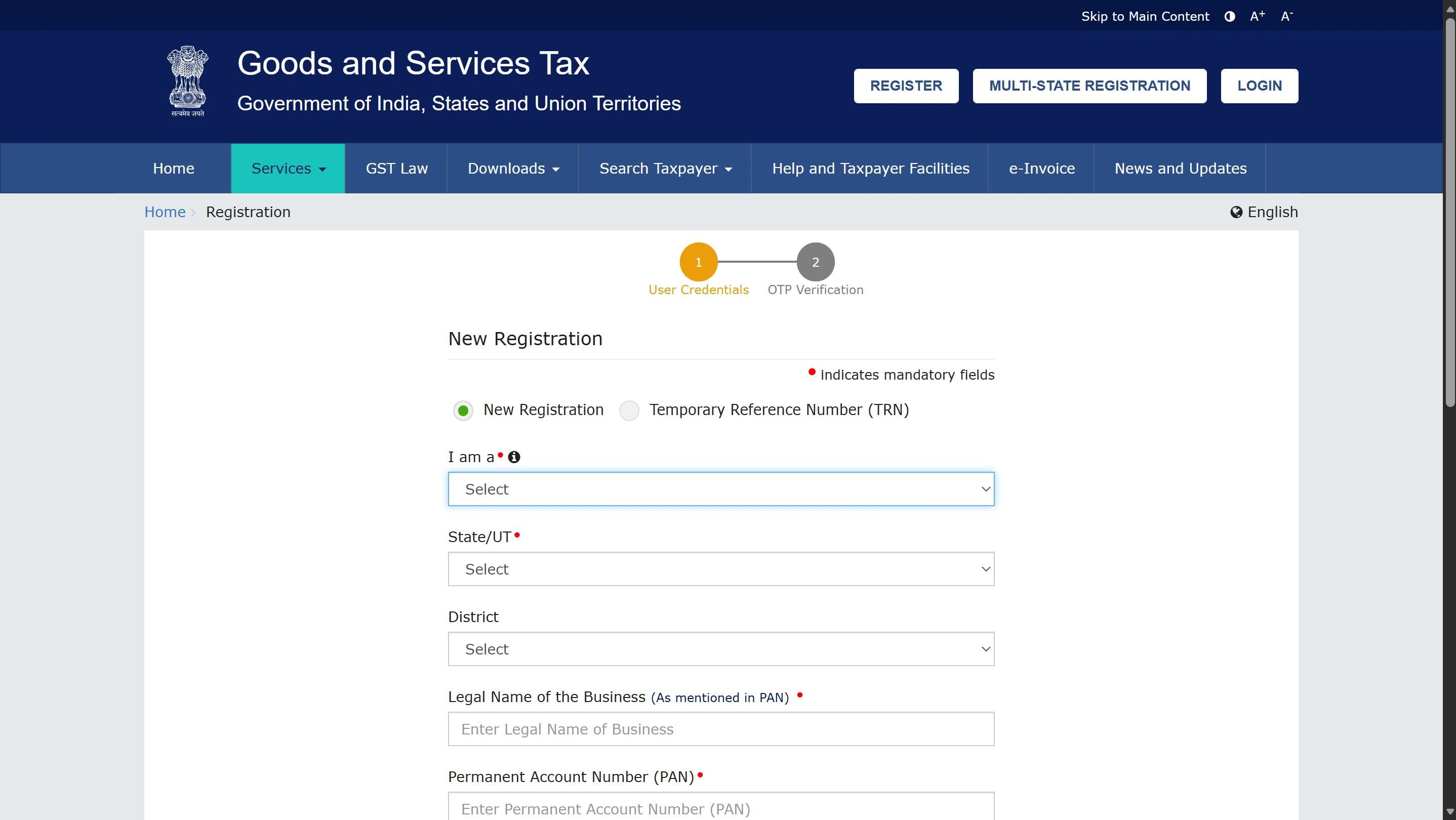
- Part A. Enter your PAN, mobile number and email. The portal verifies the PAN against income tax records and sends one-time passwords. You receive a Temporary Reference Number.
- Part B. Using that reference number, fill in the business details: constitution (proprietorship, partnership, company), places of business, goods and services you supply, bank account, and the authorised signatory.
- Documents. Typically PAN, Aadhaar of the proprietor or partners, a photograph, proof of the business address (such as a utility bill with a consent letter if the premises are rented or owned by someone else), and a bank statement or cancelled cheque. Nothing is uploaded in physical form; scans are attached online.
- Verification. Aadhaar authentication, where completed, speeds the process. The officer can approve, or raise a clarification notice asking for more information, which you answer online. A fast-track route now exists for eligible small suppliers, under which registration can be granted in about three working days.
- GSTIN. On approval you receive a 15 digit GSTIN for that state and a registration certificate. Registration is state-wise: if you supply from places of business in two states, you take a separate registration in each, under the same PAN.
From application to GSTIN, a clean application with Aadhaar authentication commonly completes within about a week. Most delays come from address proof mismatches and unanswered clarification notices, so check the portal and your email daily until the GSTIN is issued.
What changes the day you get a GSTIN
Registration is not a certificate for the wall. It changes how you bill and what you file:
- You charge GST on your taxable supplies and issue tax invoices with your GSTIN on them.
- You file returns: GSTR-1 for outward supplies and GSTR-3B for the summary and tax payment, monthly, or quarterly under the QRMP scheme if your turnover is up to Rs 5 crore.
- You can claim input tax credit on your business purchases, which an unregistered business cannot.
- Your buyers can claim credit on what they buy from you, which is precisely why larger customers insist on it.
- If your turnover in any financial year from 2017-18 onwards has crossed Rs 5 crore, e-invoicing applies to your B2B invoices. We have covered that rule separately in our guide to the Rs 5 crore e-invoicing rule.
- If your turnover is up to Rs 1.5 crore, you may be eligible for the composition scheme instead of regular registration, which trades input credit for a flat rate and simpler filing. Our composition scheme vs regular GST comparison works through which one costs less.
Should you register voluntarily below the limit?
Section 25 allows it, and there are situations where it is the right business decision even though the law does not force it:
- A large buyer makes a GSTIN a condition of the purchase order, because without your tax invoice they get no input credit.
- You want to sell inter-state, or through marketplaces that require a GSTIN for your category of sales.
- Your own purchases carry heavy GST, and staying unregistered means that tax becomes a straight cost instead of a credit.
Against that, count the real costs: returns to file every period, tax charged on every supply from the first rupee with no threshold protection, and compliance that continues even in a month with no sales. Register voluntarily because a customer or a channel requires it, or because the credit maths clearly favours it. Not because it looks more established.
One more fact to weigh: a voluntarily registered business can apply for cancellation only after one year from the date its registration took effect. Voluntary registration is a one year commitment at minimum.
Can you cancel a registration later?
Yes, if your turnover falls below the threshold and you no longer fall in any compulsory category, or if the business is closed or transferred. Cancellation requires your returns to be filed and dues paid, and it does not erase liability for the period you were registered. Businesses registered only because of a threshold crossing that no longer applies do exit the system; it is not a lifetime sentence. But plan the timing, because buyers mid-contract and stock on hand both have tax consequences on exit.
Common mistakes
- Counting only one state's sales against the limit. The test is PAN-wide.
- Assuming the Rs 40 lakh limit covers a business that also bills for services. It does not.
- Waiting until the financial year ends to check. The 30 day clock starts when you cross the limit, mid-year included.
- Treating Udyam registration as a substitute. Udyam and GST are separate registrations issued by different authorities, and one does not give you the other.
- Registering in your home state and supplying from a warehouse in another state without a registration there. Registration follows the place you supply from.
- Assuming marketplace sales are like direct sales. Selling through an operator that collects tax at source has its own compulsory rule.
Run this five question check on your own business
- Is your PAN-wide turnover this year above Rs 20 lakh? Above Rs 40 lakh?
- Do you supply any service at all, even a small one, alongside goods?
- Have you sold, or will you sell, goods to even one customer in another state?
- Do you sell, or plan to sell, through a marketplace?
- Do you receive any service on which you must pay tax under reverse charge?
If the answer to question 1 crosses the limit for your category and state, or the answer to any of questions 3, 4 or 5 is yes, you very likely need to register, whatever the turnover table said at first glance.
Frequently asked questions
Yes. The government fee on gst.gov.in is zero. Any charge is a private consultant's fee, not a government fee.
Sources: CGST Act Sections 22, 24 and 25; Notification 10/2019-Central Tax dated 7 March 2019; gst.gov.in.